



Žemaičių Naumiestis
Žemaičių Naumiestis is an old border town in Samogitia, with settlements in its surroundings dating back to the 14th century. The town gained special importance after the 1863–1864 uprising, when Lithuanian publications were banned—it became a key hub for distributing forbidden literature. One of the main book smuggling routes passed through it. From 1910 to 1914, Evangelical Lutheran pastor Friedrich Megnius published the newspaper Svečias in Lithuanian in Naumiestis, which was the only newspaper published in Samogitia at the time. More than a hundred years later, a few copies of this newspaper were found during the renovation of the Lutheran rectory.
The old market square of Žemaičių Naumiestis, cobbled and largely unchanged since the early 19th century, reflects the multicultural life of this border town. The surrounding buildings serve as living exhibits, recalling the Jewish, Lithuanian, and Lietuvinink shops, taverns, and workshops once operating there. Naumiestis hosted two weekly markets, several annual fairs, had a customs office (on the Russian-German border), about thirty shops and taverns, as well as an electric power station, a steam-powered sawmill, a watermill, a knitting workshop, a bakery, a primary school, a junior high school, a library, and more. The town was beautifully rebuilt and better planned, with sidewalks laid and the center and main streets cobbled.
The people of Naumiestis actively contributed to building Independent Lithuania. After the restoration of Lithuanian statehood in 1918, Naumiestis became the center of a local administrative unit and was known as Tauragė’s Naumiestis. In the 1930s, it began to be called Žemaičių Naumiestis.
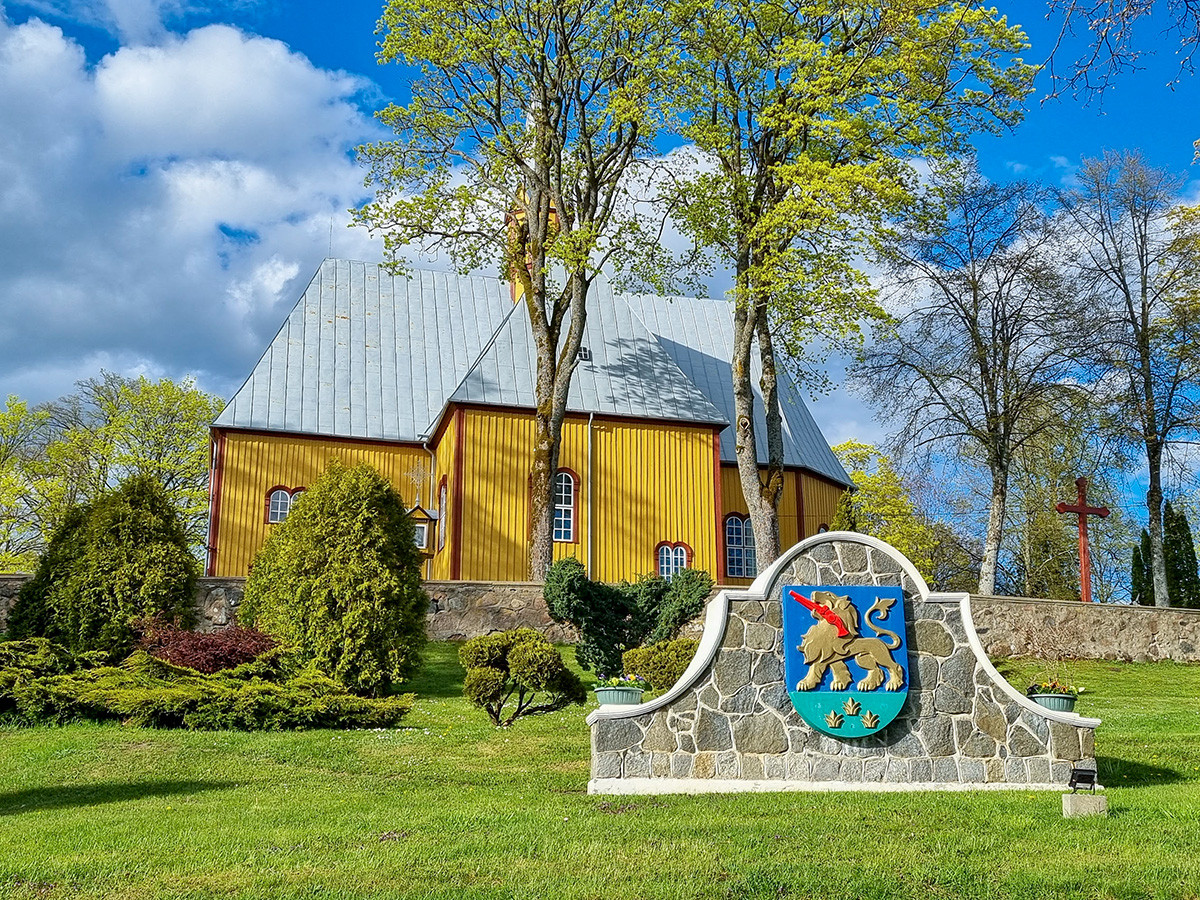
On the Vanagiai Mound, also known as Green Hill, proudly stands the Roman Catholic Church of St. Michael the Archangel, built in 1782. This wooden church, constructed in folk architectural style, features elements of neo-Gothic design. It houses religious paintings and sculptures of artistic value. The church building follows a cruciform plan with a small tower at the roof’s crossing. In 1842, a church for Evangelical Lutherans was also built. Žemaičių Naumiestis had a large Jewish community, evidenced by the still-standing massive brick synagogue built in 1816. During the Soviet era, the synagogue was used as a cultural center. Now, the building is abandoned and in disrepair. In Žemaičių Naumiestis, everyone had their place of worship. The town’s architecture has remained unchanged for many years, attracting Lithuanian filmmakers. Every autumn, a harvest festival—Dagotuvės—is held on the beautiful Green Hill.